
Home battery storage installation in Northern Ireland
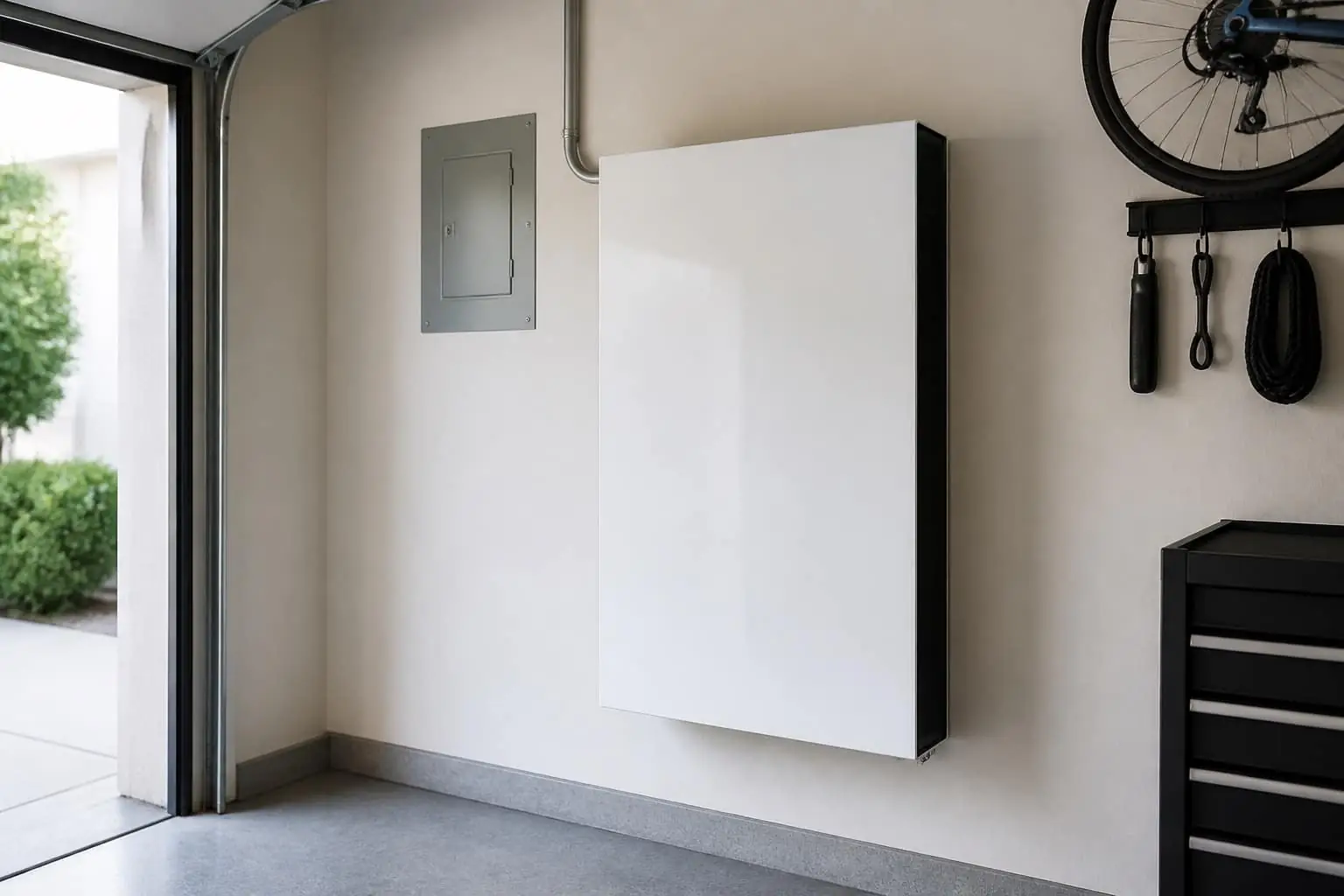
A battery keeps the solar you don't use during the day for the evening. It can also be worth fitting on its own: on a time-of-use tariff it charges on cheap night units and runs the house through the expensive evening peak.
- Free survey, fixed written quote
- Manufacturer warranties registered
- NICEIC-approved electricians
- Grid paperwork handled
The short answer
Battery storage: the essentials
Key figures at a glance
- Typical usable capacity
- 5–13 kWh for a family home
- Typical installed cost
- £3,000–£7,000 depending on size
- VAT
- 0%, including retrofit and battery-only installs
- Warranty
- 10 years and 6,000–10,000 cycles
- Self-consumption uplift
- From ~35% to ~70–85% of solar generated
- Install time
- Half a day to a full day
What we do differently on battery storage
Use far more of what you generate
Without a battery, a typical household uses about a third of its solar directly. The rest is exported for a few pence. A correctly sized battery lifts self-consumption to around 70–85%, and every unit shifted is worth the difference between your import rate and your export rate.
Charge on cheap night units
On an Economy 7 or smart time-of-use tariff the battery charges overnight at the low rate and discharges through the evening peak. On its own that can be worth several hundred pounds a year, which is why battery-only retrofits now make sense for households without a suitable roof.
Backup power when the network drops
With a backup gateway fitted, essential circuits such as lighting, the fridge and freezer, broadband and an oil boiler keep running through an outage. Worth specifying if you are on a rural feeder in Fermanagh, Tyrone or the Glens where storm-related interruptions are more common.
Sized on your evening load
Oversizing a battery is the most common way to ruin the payback. We model your overnight and evening demand against your generation profile and specify the capacity that will actually cycle every day, then leave headroom to expand later if your load grows.
What you get for the price we quote
Every item below is in the fixed price. If something is not on this list and turns out to be needed, we find it at the survey, not on install day.
- Consumption profiling from smart meter or bill data
- LFP (lithium iron phosphate) battery, a safer chemistry with a longer cycle life
- Hybrid or AC-coupled inverter to suit new or existing solar
- Optional backup gateway for essential circuits
- Tariff optimisation and charge-schedule setup
- Electrical installation certificate
- NIE Networks notification
- App-based monitoring and remote support
From enquiry to switch-on
- Step 1
Desktop assessment
Send us your address and a recent bill. We model your roof from satellite imagery and location-specific irradiance data, and tell you straight away whether it is worth a visit.
- Step 2
Free on-site survey
An engineer checks roof structure and covering, shading through the day, your consumer unit, earthing arrangement and cable routes. This is what makes a fixed price possible.
- Step 3
Fixed written quote
A single page with the system, a generation estimate for your specific roof, the price with nothing excluded, and a realistic payback based on your actual consumption.
- Step 4
Design and approvals
We finalise the electrical design and submit the NIE Networks G98 notification or G99 application, plus building control notification. You do not fill in a form.
- Step 5
Installation
Scaffolding up, system in, tested and commissioned. Most domestic solar installations take one to two days; batteries and EV chargers, half a day to a day.
- Step 6
Handover and aftercare
We set up your monitoring app, walk you through the system, and issue your electrical certificates and warranties. We submit the NIE Networks notification on your behalf.
Questions about battery storage
How much does a home battery cost in Northern Ireland?
Expect roughly £3,000–£4,500 for a 5 kWh system, £4,500–£6,000 for around 10 kWh, and £6,000–£7,500 for 13 kWh and above, fully installed with 0% VAT. Fitting a battery at the same time as solar is cheaper than a later retrofit because the hybrid inverter, scaffolding and electrical works are shared.
Can I get a battery without solar panels?
Yes, and it is increasingly common. A battery-only install charges from the grid on a cheap night rate and discharges during the expensive evening peak. It also carries 0% VAT in its own right following the April 2024 change to the energy-saving materials relief, so you no longer need panels to qualify.
What size battery do I need?
Most Northern Ireland households land between 5 kWh and 13 kWh of usable capacity. The right figure is roughly your evening and overnight electricity use, which for a typical home is 6–10 kWh. Going bigger than your daily cycle simply adds cost that never gets used, so we size from your actual consumption data.
Do batteries work during a power cut?
Only if a backup gateway is specified. A standard grid-tied battery shuts down in an outage for safety, because it must not energise a network that engineers may be working on. Adding an islanding-capable gateway lets the battery run selected essential circuits while staying safely disconnected from the grid.
How long do home batteries last?
Modern lithium iron phosphate batteries are warranted for 10 years and typically 6,000–10,000 full cycles, retaining around 70–80% of capacity at end of warranty. Cycling once a day, that is a realistic service life well beyond the warranty period.
Are home batteries safe?
The LFP chemistry we install is thermally stable and does not contain cobalt, making it substantially more fire-resistant than the NMC cells used in older products. Units are installed to BS 7671, in a ventilated location away from escape routes, with isolation and fire detection as required by the risk assessment.
Works even better with
- Solar panelsSolar panels for homes, farms and commercial roofs across Northern Ireland, with a free roof survey, a generation estimate for your roof and the NIE Networks paperwork handled.
- EV chargersEV charger installation across Northern Ireland: 7kW home chargers, solar-linked charging and workplace charge points, at a fixed price after a survey.
Battery storage across Northern Ireland
Get a quote for your home
Send us your postcode and a recent bill. We'll model your roof and tell you whether solar is worth it there. If it is, we survey and give you a fixed written price.