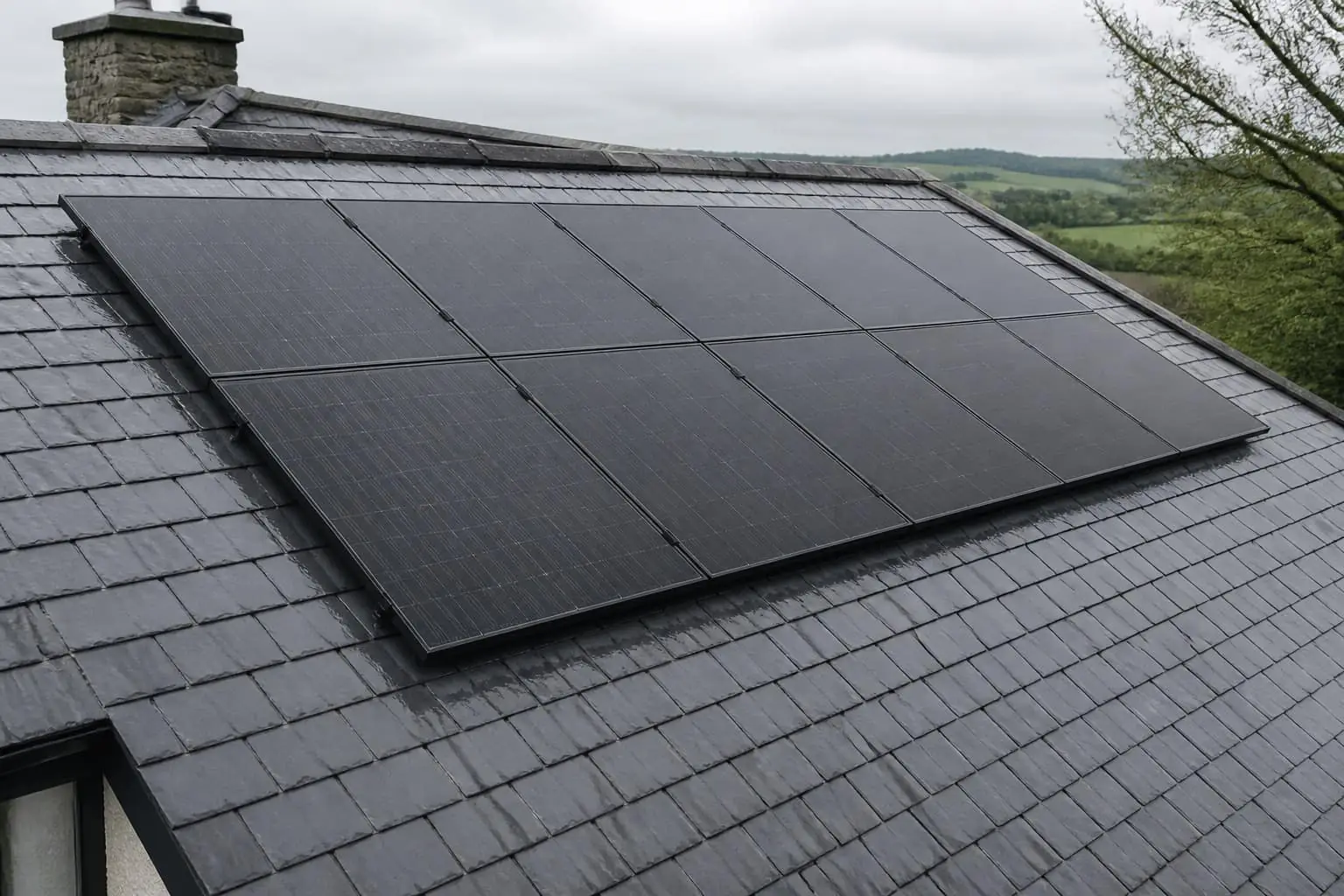
Solar panel installation in Northern Ireland
Northern Ireland gets less sun than the south of England, but its electricity unit rates are among the highest in the UK, so solar still pays back here. We size the system from your half-hourly consumption, so you buy the array that fits your bills, not the biggest one that fits your roof.
- Free survey, fixed written quote
- Manufacturer warranties registered
- NICEIC-approved electricians
- Grid paperwork handled
The short answer
Solar panels: the essentials
Key figures at a glance
- Typical domestic system
- 4–6 kWp (10–15 panels)
- Typical installed cost
- £5,000–£9,000 including scaffolding
- Annual generation in NI
- 850–950 kWh per kWp installed
- VAT
- 0% on domestic installs until 31 March 2027
- Typical payback
- 7–10 years at current NI unit rates
- Install time
- 1–2 days on a standard domestic roof
What we do differently on solar panels
Sized against your real consumption
We pull your half-hourly smart meter data where it exists, or work from 12 months of bills where it doesn't. Self-consumption is what drives the return in Northern Ireland, because you save the full ~27p import rate on every unit you use yourself and earn far less on units you export.
Generation modelled on your roof
Every quote includes a generation estimate using your roof's actual pitch, orientation and shading, not a best-case south-facing figure. If your roof will not perform, we will tell you before you spend anything.
Structural and electrical checks first
We survey rafter spacing, roof covering condition and your consumer unit before we design. On older NI housing stock a board upgrade or a rafter reinforcement is not unusual, and it is far cheaper to find it at survey than on install day.
All grid paperwork handled
Systems up to 3.68 kW per phase are notified to NIE Networks under G98 after commissioning. Anything larger needs G99 approval before it is connected, which adds lead time. We manage both, plus building control notification.
What you get for the price we quote
Every item below is in the fixed price. If something is not on this list and turns out to be needed, we find it at the survey, not on install day.
- Free roof survey and shading analysis
- Generation estimate specific to your roof
- Monocrystalline panels with a 25-year performance warranty
- Hybrid inverter (battery-ready) with 10–12 year warranty
- Full scaffolding, mounting, DC and AC works
- NIE Networks G98 notification or G99 application
- Electrical installation certificate and building control notification
- Generation monitoring app set up on your phone
From enquiry to switch-on
- Step 1
Desktop assessment
Send us your address and a recent bill. We model your roof from satellite imagery and location-specific irradiance data, and tell you straight away whether it is worth a visit.
- Step 2
Free on-site survey
An engineer checks roof structure and covering, shading through the day, your consumer unit, earthing arrangement and cable routes. This is what makes a fixed price possible.
- Step 3
Fixed written quote
A single page with the system, a generation estimate for your specific roof, the price with nothing excluded, and a realistic payback based on your actual consumption.
- Step 4
Design and approvals
We finalise the electrical design and submit the NIE Networks G98 notification or G99 application, plus building control notification. You do not fill in a form.
- Step 5
Installation
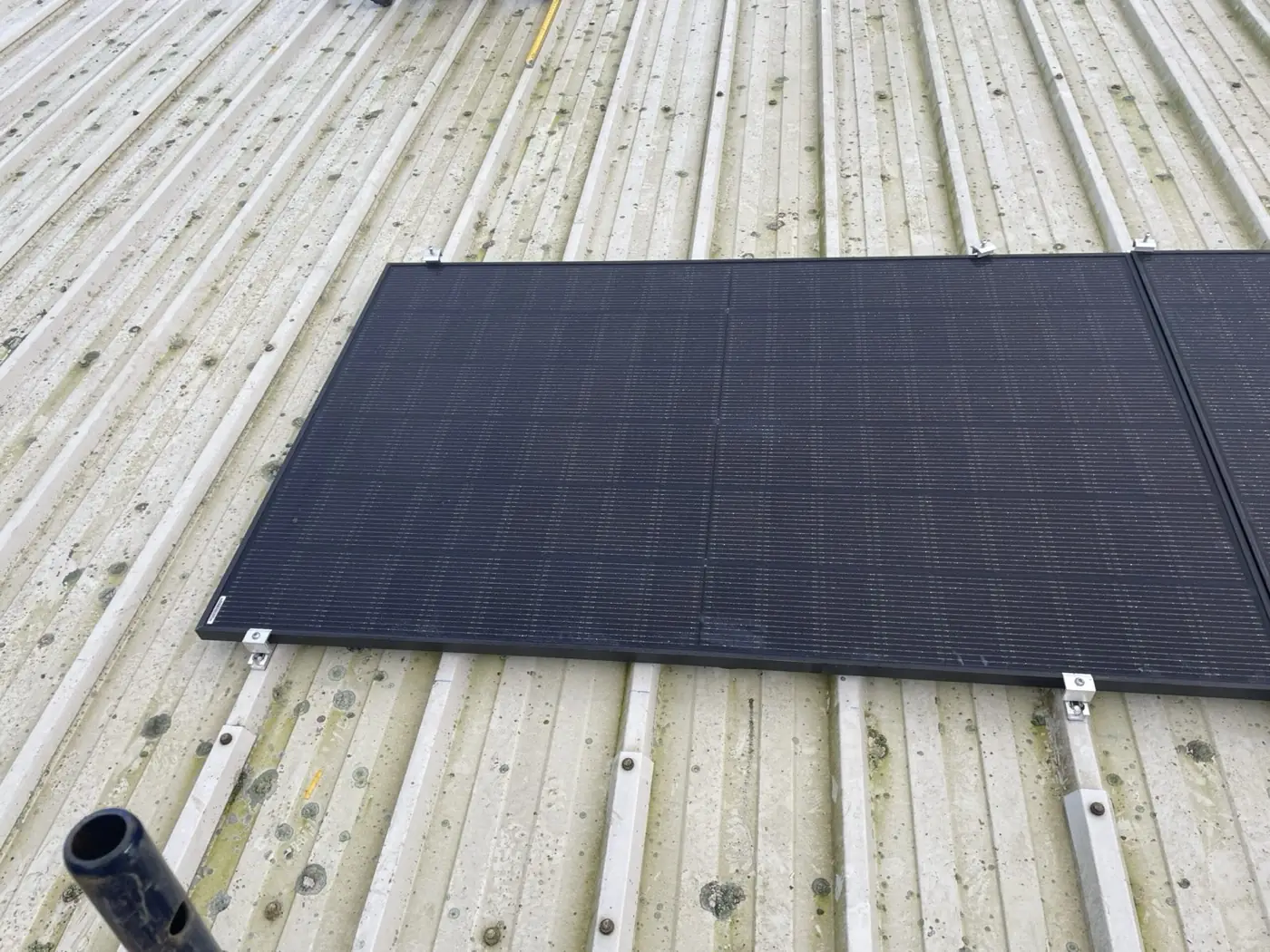
Scaffolding up, system in, tested and commissioned. Most domestic solar installations take one to two days; batteries and EV chargers, half a day to a day.
- Step 6
Handover and aftercare
We set up your monitoring app, walk you through the system, and issue your electrical certificates and warranties. We submit the NIE Networks notification on your behalf.
Questions about solar panels
Do solar panels work in Northern Ireland?
Yes. Northern Ireland receives roughly 850–950 kWh per kWp of installed solar per year, around 10–15% less than the south of England, but well within the range where solar pays back. Panels run on daylight, not heat, and NI's cooler climate actually improves panel efficiency. High local electricity prices mean each unit you generate is worth more here than in most of the UK.
How much do solar panels cost in Northern Ireland?
A typical 4 kWp domestic system costs around £5,000–£6,500 fully installed, and a 6 kWp system around £7,000–£9,000. Adding a battery usually adds £3,000–£5,000. Prices include scaffolding and VAT at 0%. Larger commercial and agricultural roofs work out cheaper per kWp.
Do I need planning permission for solar panels in Northern Ireland?
For most homes, no. Roof-mounted solar is usually permitted development in Northern Ireland provided panels do not protrude more than 200mm from the roof plane and do not sit above the highest part of the roof. Listed buildings, conservation areas and some ground-mounted arrays do need permission. We check your property's status as part of the survey.
Do I get paid for exporting solar in Northern Ireland?
Yes, but through a different route than the rest of the UK. The Smart Export Guarantee is a Great Britain scheme and does not apply in Northern Ireland. Instead, NI suppliers including Power NI, SSE Airtricity, Budget Energy and Electric Ireland offer voluntary microgeneration export tariffs, typically in the region of 4–6p per kWh. You will need NIE Networks registration, and some suppliers still ask for an MCS certificate. Confirm the current requirements with yours.
How long do solar panels last?
Panels are warranted for 25 years at typically 85–87% of original output and generally keep producing well beyond that. Inverters are the shorter-lived component, with 10–12 year warranties and a realistic service life of 12–20 years. Mounting systems are aluminium and stainless steel and are designed to outlast the panels.
Will solar panels damage my roof?
Not when installed correctly. Mounting brackets fix to the rafters, not the tiles, and lead or proprietary flashings restore weathertightness at each penetration. We survey the roof covering first. If slates or tiles are near end of life, we will recommend addressing that before the array goes on, because removing panels later is an avoidable cost.
Works even better with
- Battery storageHome and commercial battery storage installed across Northern Ireland. Store your solar, charge on cheap night rates, keep the lights on in a power cut.
- EV chargersEV charger installation across Northern Ireland: 7kW home chargers, solar-linked charging and workplace charge points, at a fixed price after a survey.
Solar panels across Northern Ireland
Get a quote for your home
Send us your postcode and a recent bill. We'll model your roof and tell you whether solar is worth it there. If it is, we survey and give you a fixed written price.