

- most a panel can stand off a road-facing roof
- 20 cm
- largest garden array at a house, 2 m high
- 14 m²
- largest stand-alone array at a farm or business
- 30 m²
The short answer
Do you need planning permission for solar panels in Northern Ireland?
Most houses in Northern Ireland do not need planning permission for solar panels. Roof panels are permitted development if they stay below the ridge and inside the roof edge. On a roof slope that faces and can be seen from a road, they can stand off the roof by no more than 20 cm. You do need permission for a listed building, a flat, or a road-facing roof in a conservation area.
Quick check: do you need to apply?
| Your project | Planning permission? |
|---|---|
| Panels on a house roof, within the limits below | Not needed |
| Panels on a shed or garage roof in your garden | Not needed, same limits |
| Front roof facing the street, in a conservation area | Needed |
| Any panels on a listed building or in its grounds | Needed, plus listed building consent |
| Panels on a flat or apartment block | Needed |
| One garden array up to 14 m² and 2 m high | Not needed |
| Panels on a farm shed, shop or office roof | Not needed, within limits |
| Field array over 30 m² at a farm or business | Needed |
Northern Ireland has its own rules
Planning is devolved. The rules for solar panels here are in the Planning (General Permitted Development) Order (Northern Ireland) 2015. Part 2 covers houses. Part 37 covers farms, shops and other non-domestic buildings.
Work that meets those rules is "permitted development". It already has planning permission, so there is nothing to apply for.
Many planning guides online describe England, which has its own order and its own limits. A garden array in England is capped at 9 square metres, for example; here the limit is 14. If a guide does not mention Northern Ireland, it is probably describing England.
We checked this guide against the Order on legislation.gov.uk on 16 October 2026. Amendments in 2023 and 2026 changed the rules for heat pumps and shops, not for solar panels.
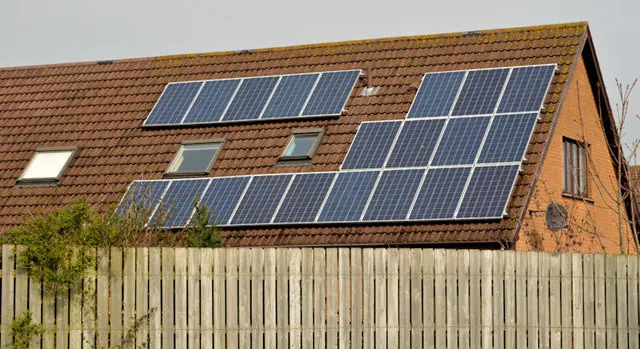
Panels on a house roof
Class A of Part 2 allows solar PV or solar thermal panels on the roof of a house. It also covers a shed, garage or other building in the garden. The panels must stay within these limits:
- On a roof slope that faces onto and can be seen from a road, no part can stand more than 20 cm off the roof. The Order sets no stand-off limit for slopes that cannot be seen from a road.
- No part can be higher than the highest part of a pitched roof, or more than 1.5 m above a flat roof.
- No part can extend past the edge of the roof.
- In a conservation area or World Heritage Site, a roof slope that faces and can be seen from a road is excluded. So is a flat roof where the panels would be visible from a road.
- On a listed building, or anywhere in its grounds, you need listed building consent first.
- Road-facing slope. Panels can stand off the roof by no more than 20 cm. The dotted line is the view from the road.
- Slope not seen from a road. No stand-off limit in the Order.
- Ridge and edges. Nothing above the highest part of the roof, and nothing past the roof edge.
- Garden array. One only, up to 14 m² and 2 m high, and no nearer the road than the house.
Panels on a wall
Class B allows panels on the wall of a house or outbuilding, or on a garden wall. Within 3 m of your boundary, panels higher than 4 m can stand off the wall by no more than 20 cm. They cannot extend past the edge of the wall, and on a chimney wall they cannot go above the roof.
In a conservation area or World Heritage Site, a wall that faces and can be seen from a road is excluded. Listed buildings need consent first.
Panels in the garden
Class C allows one stand-alone array in the garden of a house without planning permission. It must:
- cover no more than 14 square metres, about seven standard panels;
- be no more than 2 m high;
- be no nearer to a road bounding the property than the nearest part of the house;
- not be in the grounds of a listed building, unless listed building consent has been granted.
Conservation areas, the Causeway and listed buildings
Conservation areas and the Giant's Causeway World Heritage Site keep permitted development for roof slopes and walls that cannot be seen from a road. A front roof facing the street needs a planning application.
A listed building needs listed building consent. Until consent is granted, panels anywhere in its grounds are outside permitted development.
Each council publishes its own conservation areas. Our area pages link to the planning service for every council we cover, and we check your property's status before we quote.
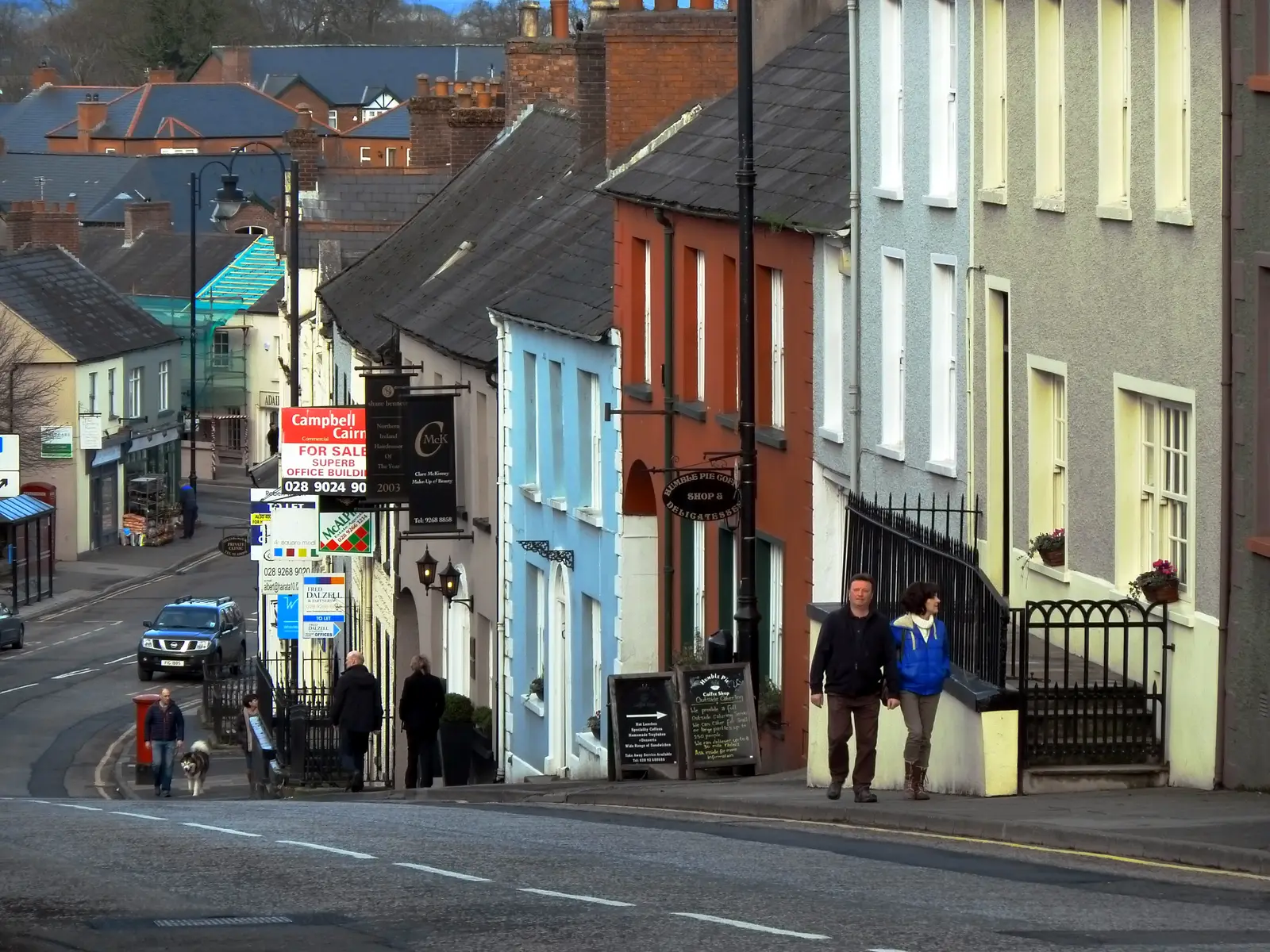
Flats and apartments
The Order's definition of a house leaves out flats and buildings that contain flats. Part 37, the non-domestic rules, leaves out blocks of flats too.
So permitted development does not cover solar panels on flats or apartment blocks. They need a planning application, and the agreement of whoever owns or manages the building.
Farms, shops and other businesses
Part 37 covers buildings that are not houses or flats: farm sheds, workshops, shops and offices. Class A allows panels on their roofs and walls without planning permission, as long as:
- on a slope that faces and can be seen from a road, nothing stands more than 20 cm off the roof;
- on a flat roof, nothing is more than 2 m above the highest part of the roof, or within 2 m of its outer edge;
- nothing extends past the roof or wall, or rises above the ridge of a pitched roof;
- in a conservation area or World Heritage Site, nothing goes on a wall or roof slope that faces and can be seen from a road;
- on a listed building or in its grounds, listed building consent has been granted first;
- the panels are sited, as far as practicable, to keep the effect on the building and the area to a minimum.
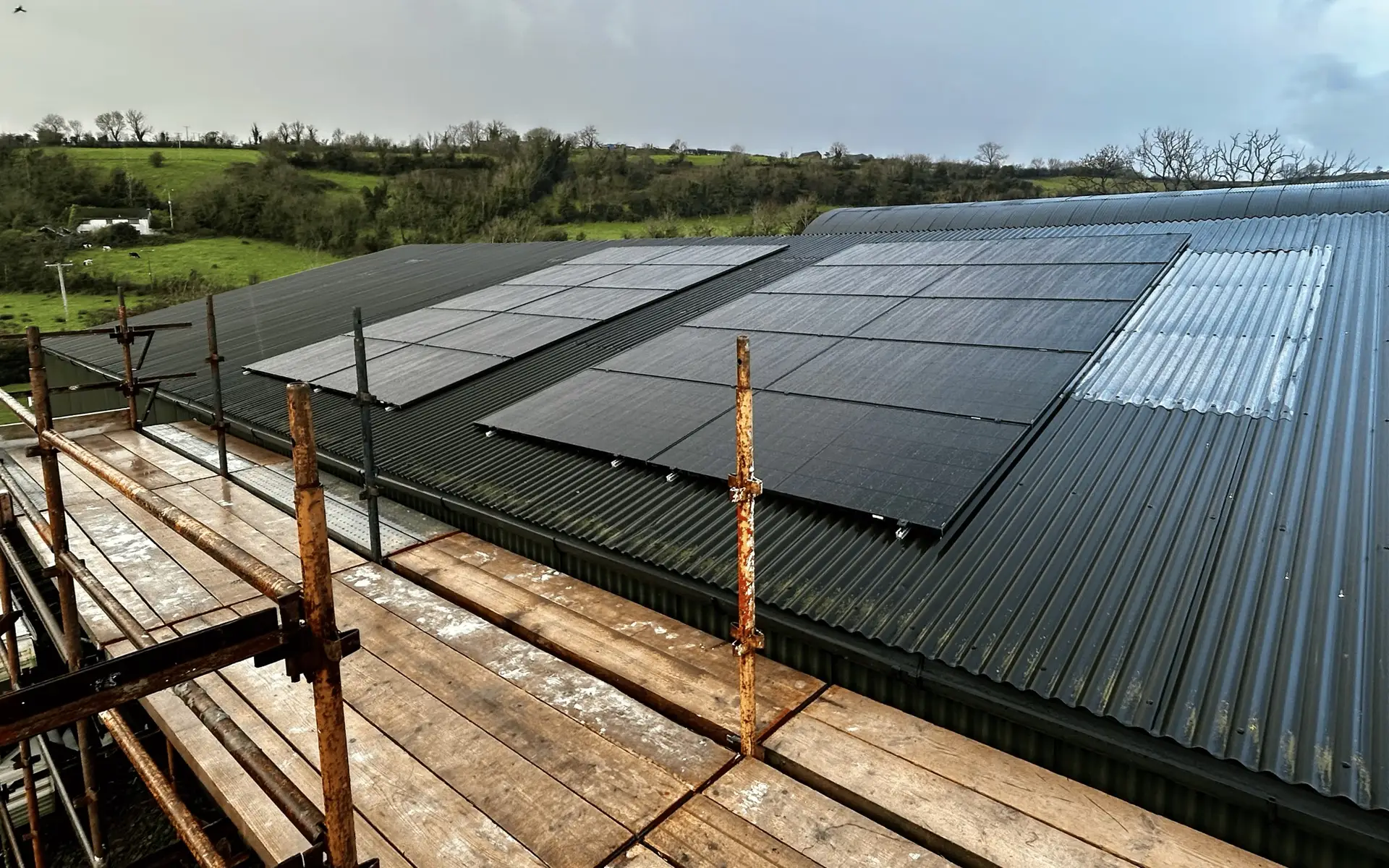
Ground-mounted arrays at a farm or business
Class B of Part 37 allows a stand-alone array in the grounds of a non-domestic building without planning permission. It must be:
- no more than 2 m high and no more than 30 square metres;
- at least 5 m from the boundary;
- outside any area of special scientific interest or site of archaeological interest;
- not facing and visible from a road, in a conservation area or World Heritage Site;
- outside the grounds of a listed building, unless listed building consent has been granted.
Is there a kW limit?
No. Neither Part 2 nor Part 37 limits a system's output. The limits are about where panels go and how far they stand off the building.
Size matters for the grid instead. Every system needs a G98 notification or G99 application to NIE Networks, which we prepare and submit for you.
What can take permitted development away
- A condition on the planning permission for your house. Some newer estates have one (article 3(4) of the Order).
- An article 4 direction, which a council can make to remove permitted development in a particular area.
- On a house, the panels must mainly supply that house, and panels no longer in use must be removed.
Getting it in writing
If you want certainty, for example before you sell, ask your council for a certificate of lawfulness of proposed use or development. It is issued under section 170 of the Planning Act (Northern Ireland) 2011.
The council only confirms that the work would be lawful. It does not judge whether the work is a good idea.
Sources
- Permitted Development Order (NI) 2015, Part 2: houses
- Permitted Development Order (NI) 2015, Part 37: non-domestic buildings
- Lisburn & Castlereagh City Council: conservation areas
- Permitted Development Order (NI) 2015, article 2: definitions
- Permitted Development Order (NI) 2015, article 3
- Permitted Development Order (NI) 2015, article 4
- Planning Act (Northern Ireland) 2011, section 170
Frequently asked questions
Do I need planning permission for solar panels in Northern Ireland?
For most houses, no. Roof panels are permitted development if they stay below the ridge and inside the roof edge. On a slope that faces and can be seen from a road, they can stand off the roof by no more than 20 cm. Listed buildings, flats, and road-facing roofs in conservation areas need permission.
Can I put solar panels on the front of my house in Northern Ireland?
Usually, yes. A road-facing roof slope is permitted development if no part of the panels stands more than 20 cm off the roof. The exceptions are listed buildings, and houses in a conservation area or World Heritage Site, where a roof slope that faces and can be seen from a road needs planning permission.
Do I need planning permission for solar panels in my garden?
Not for one stand-alone array of up to 14 square metres and 2 m high, placed no nearer to a road than the house itself. A second array, a bigger one, or one in the grounds of a listed building needs permission.
Do farm sheds need planning permission for solar panels in Northern Ireland?
Usually not for panels on the roof. Part 37 of the Order allows panels on non-domestic buildings, including farm sheds, within height and edge limits. A ground-mounted array is allowed up to 30 square metres and 2 m high, at least 5 m from the boundary. Anything larger needs a planning application.
Is there a size limit in kW for solar without planning permission?
No. The Northern Ireland rules limit where panels go and how far they stand off the roof, not the system's output. Size matters for the grid connection instead, which NIE Networks handles through G98 or G99.